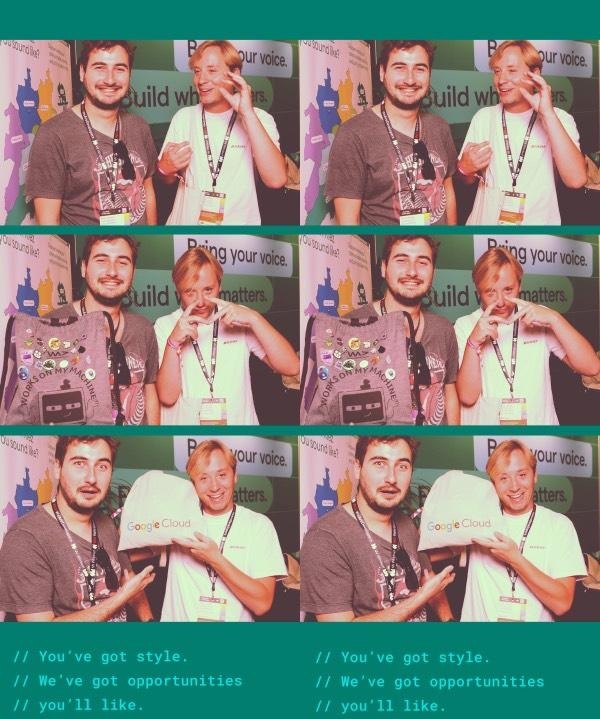
I spent last week in Berlin at the WeAreDevelopers World Congress, a three-day gathering of thousands of software professionals, all united by a passion for building the future (and a healthy obsession with stickers and pins!). As a Codit developer specializing in Azure, .NET, and containerization, I dove headfirst into sessions on cloud-native architectures, microservices design patterns, and Kubernetes best practices. Beyond the insightful talks, I explored the exhibition floor where every company booth offered not just irresistible swag, but eye-opening demos and conversations about the latest in tooling and tech.
Now, let’s jump into the key takeaways from the sessions that made this trip truly unforgettable.
“Agents for the Sake of Happiness” – Thomas Dohmke
GitHub CEO Thomas Dohmke opened the conference with a keynote on AI, developer empowerment, and what he called “developer happiness.”
Dohmke shared how GitHub Copilot has evolved from autocomplete to a coding agent that can migrate tests, fix bugs, and add features—all from natural language prompts. He urged developers to think of themselves less as coders and more as orchestrators, guiding and validating AI output.
Key insights:
-
AI tools like Copilot amplify creativity and free us from repetitive work.
-
Natural language coding lowers barriers for beginners and non-native speakers.
-
AI agents will increasingly handle grunt work, letting developers focus on design and strategy.
-
Microsoft and GitHub envision “a billion developers” empowered by AI.
For me, this resonated with how we at Codit are already integrating AI into workflows, but also challenged us to think even bigger.
“Infrastructure as Prompts” – Marcel Scherenberg
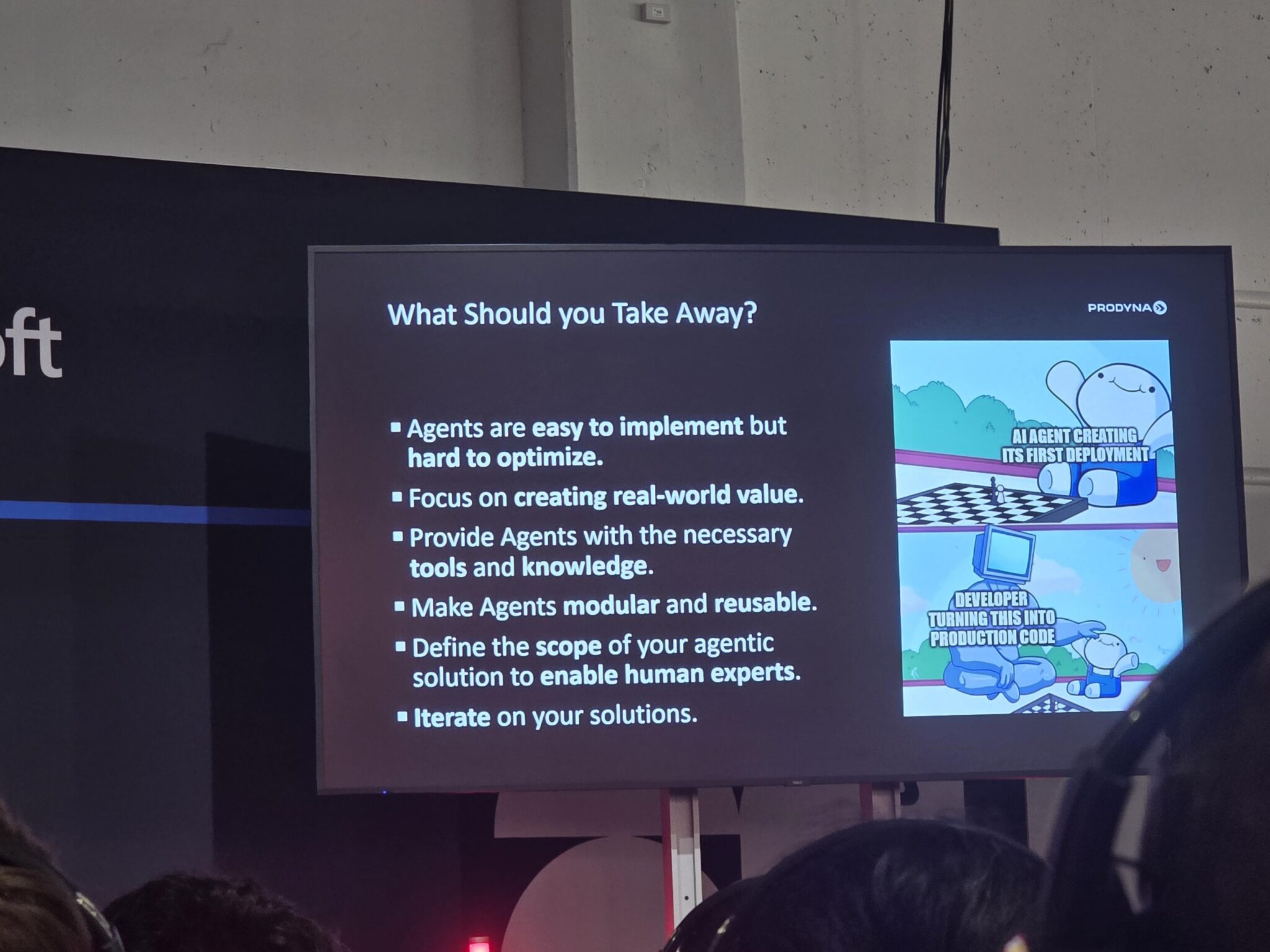
Marcel Scherenberg (PRODYNA) showcased how AI agents can turn natural language into production-ready Azure infrastructure code.
Instead of manually coordinating between architects, engineers, and compliance officers, Marcel demonstrated how AI agents generate Terraform/Bicep code, validate it, and deploy autonomously—integrating GDPR and FinOps considerations along the way.
Key insights:
-
Infrastructure-as-Prompt translates requirements into code and deploys iteratively.
-
Multi-agent setups simulate entire DevOps teams.
-
Human oversight remains essential, but AI dramatically speeds up delivery.
This aligns closely with Codit’s Azure automation focus and shows the potential of AI-driven provisioning to revolutionize internal tooling and client onboarding.
“Azure Well-Architected Framework in Practice” – Paweł Siwek
Paweł Siwek (Dynatrace) brought a practical perspective to building resilient, mission-critical cloud systems.
He emphasized designing for failure using patterns like bulkheads, retries, and circuit breakers, and highlighted how observability tools like Azure Monitor and Dynatrace enable proactive issue detection.
Key insights:
-
Resilience isn’t optional; failures are inevitable.
-
True mission-critical systems prioritize availability over cost.
-
Multi-cloud setups often add complexity instead of reliability.
This session was a timely reminder that while AI accelerates development, rock-solid architecture remains the foundation.
“The Future of Stack Overflow” – Prashanth Chandrasekar & Jody Bailey
Stack Overflow’s CEO and CTO tackled the big question: if AI can generate code, why use Stack Overflow? Their answer: trust.
They outlined how Stack Overflow is integrating AI experiences grounded in human-validated knowledge while evolving into a more interactive community hub.
Key insights:
-
AI + humans is the way forward; quality content remains key.
-
Enterprise Stack Overflow integrations power AI agents with trusted domain knowledge.
-
Partnerships with OpenAI and Google embed SO data into new coding tools.
The message: AI will enhance, not replace, the developer community, and Stack Overflow wants to remain its trusted backbone.
“Lessons from Observing a Billion API Requests” – Pratim Bhosale
Pratim Bhosale (Treblle) shared data-driven insights from analyzing a billion API requests, highlighting common pitfalls and future trends.
Key insights:
-
API traffic surged 800% in 2024, driven by AI agents.
-
Half of APIs lack authentication, leaving systems vulnerable.
-
APIs must now be “AI-ready” with rich schemas and documentation.
-
Security should be treated as a product feature, not an afterthought.
Her practical advice on composable, well-documented APIs is crucial for anyone building scalable, secure systems in an AI-driven world.
“Data Analytics with Microsoft Fabric” – Hanna Schwab & Alexander Wachtel
This duo demonstrated how Microsoft Fabric unifies data workflows and adds conversational AI agents for natural language analytics.
Key insights:
-
OneLake simplifies integration across ERP, CRM, and warehouse data.
-
Data agents translate plain-English queries into SQL/KQL/DAX.
-
Fabric shows promise but still has preview limitations around scale and language support.
Their demo highlighted how AI-driven Q&A could soon become the default interface for enterprise analytics.
Final Thoughts
The WeAreDevelopers World Congress 2025 was a powerful testament to one undeniable truth: the developer landscape is being fundamentally reshaped by AI. From intelligent coding agents and prompt-driven infrastructure to AI-infused data analytics and the evolution of knowledge platforms like Stack Overflow. The message is clear, AI isn’t just a tool, it’s becoming an integral partner in how we build, deploy, and learn, a shift that deeply resonates with Codit’s mission to drive intelligent cloud and integration solutions.