AI is evolving rapidly, very rapidly.
But AI only becomes truly useful when it can communicate securely with your systems. The Model Context Protocol (MCP) standard makes this possible, a common language that allows AI models to call tools, data, and services without complicated integrations.
What are MCP Servers
As software engineers, we’re always chasing ways to make systems more connected, more capable, more context-aware. These days one of the hottest bridges in the AI world is the protocol known as the Model Context Protocol (MCP) — a standard that enables AI models and applications to interface with external tools, data sources, services.
To get everyone on the same page: an MCP server is a service that exposes certain capabilities (data access, tool calls, workflows) to an AI agent or host through a standard protocol. In other words: instead of every AI model and system having to invent its own way to talk to your database, filesystem, or API, MCP defines a common language and transport.
A simple way to visualize the architecture:
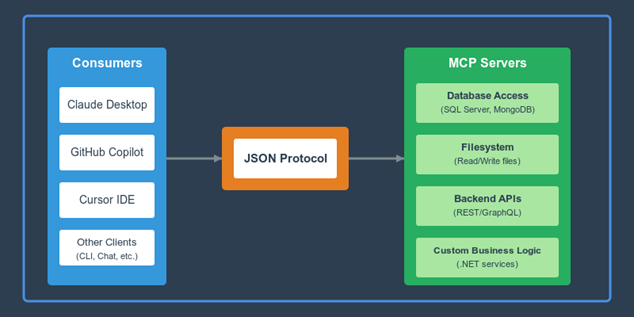
The MCP architecture is typically: Host (AI app) ↔ MCP Client ↔ MCP Server. The host uses a client to connect to one or more servers. The server declares what tools it exposes, and the host (via the client) can ask for those tools, call them, etc.
The rise of the MCP: a new bridge between AI and your systems.
Modern AI systems are getting smarter — but they’re still limited by what they can access. That’s where the Model Context Protocol (MCP) comes in. MCP defines a universal way for AI applications to talk to external systems, tools, and data sources — securely and consistently.
Think of it as a standardized API for AI integration. Instead of every app building its own ad-hoc API or plugin system, MCP provides a shared protocol that any language or platform can implement. Your APIs, Logic Apps connectors, or any service could act as an MCP server — instantly making their capabilities “AI-callable.”
This means your existing backend systems can become first-class participants in AI workflows. Whether you’re working in .NET, Python, Java, or something else — you can expose business logic, data, or automation directly to AI agents using the same standardized contract.
In a follow-up post, we’ll zoom in on what this looks like in practice for .NET developers: how Microsoft’s C# SDK for MCP works, and how you can build your own MCP server to expose your domain-specific logic to AI hosts.
Why MCP matters for developers building with or for AI
The Model Context Protocol (MCP) is more than just another interface standard — it’s a bridge between AI systems and the real world. What makes MCP so powerful is that it works in both directions, enabling a two-way flow of intelligence and control.
If you’re building applications that use AI, MCP lets your app securely connect to external knowledge and services — without hardcoding integrations or exposing raw APIs. Your app can ask the AI to perform tasks using tools defined on the MCP server, such as querying a database, processing a document, or triggering a workflow.
But if you’re building applications that AI systems will use, MCP gives you a clean way to expose your domain logic to AI hosts like ChatGPT or Copilot. You can wrap your business APIs or workflows as MCP tools — so any AI agent that speaks the protocol can discover and call them safely. Suddenly, your system isn’t just another backend; it becomes part of an AI-driven ecosystem.
MCP introduces a new layer of trust between AI systems and enterprise data. Unlike traditional APIs, an MCP server often acts on behalf of intelligent agents that can make decisions or trigger actions on your systems. This changes the stakes: authentication, authorization, and auditing aren’t optional features to tack on later — they are fundamental to the design. Developers need to think carefully about not just what data to expose, but also what operations an AI should be allowed to perform, and under which conditions.
For example, an AI agent might be able to query sensitive business data, generate reports, or even initiate workflows. Without the safeguards built into an MCP server, these capabilities could be misused, either accidentally or maliciously. By enforcing strict access control and logging all interactions, MCP servers give developers confidence that their systems remain secure while still enabling AI to act intelligently.
In practice, this means designing your MCP tools with intention: each endpoint or operation should have clear permissions, predictable behavior, and traceable results. Developers must balance flexibility and utility with security and trust — defining not just what the AI can do, but how it can do it safely. This shift in mindset is what makes MCP a powerful bridge between autonomous AI systems and real-world enterprise systems.
In short:
- Developers using AI gain structured access to real-world data and actions.
- Developers building for AI make their systems AI-ready through a shared, open standard.
When to use an MCP server
You don’t need an MCP server for every AI project — it shines when AI needs to safely access your system’s data, tools, or workflows.
Use an MCP server when:
- Your AI app should query or act on business data.
- You want to make existing APIs or services AI-ready without redesigning them.
- You’re building an AI system that needs to connect to multiple backends through one consistent interface.
- You need a secure, auditable bridge between AI and internal systems.
Think of MCP as the difference between letting an AI read your system and letting it collaborate with it. When your AI needs to do something real — perform an action, fetch data, or trigger a process — but you still need to maintain control, visibility, and trust, that’s when an MCP server becomes essential.
Conclusion
Beyond its role as a secure bridge, MCP is also a well-defined protocol. An MCP server exposes tools — structured operations the AI can call — each described with typed parameters, human-readable descriptions, and expected results. The protocol defines operations such as listing available tools, describing them, and safely invoking them, all over a secure transport channel. Each tool can map to one backend action or multiple, depending on your design.
For developers who want to dive deeper into the protocol itself — the message flow, the security model, data contracts, and implementation guidelines — the official MCP specification provides the full details:
Subscribe to our RSS feed
Talk to the author
Contact Louis
Developer